Socratic Thinking: A Practical Operating System for Small Business Owners
In the life of a small or mid-sized business owner, decisions are constant, fast-moving, and often made under pressure. Hiring, pricing, expansion, restructuring - each carries real consequences, and the margin for error is thin.
What separates reactive operators from consistently effective leaders is not just experience. It is the quality of their thinking.
One of the most underutilized yet powerful frameworks available is Socratic Thinking. While it originates in philosophy, its real value lies in how it sharpens judgment, reduces blind spots, and creates a disciplined approach to decision-making.
At its core, Socratic thinking is about asking better questions before acting.
The Five-Step Socratic Method in Business
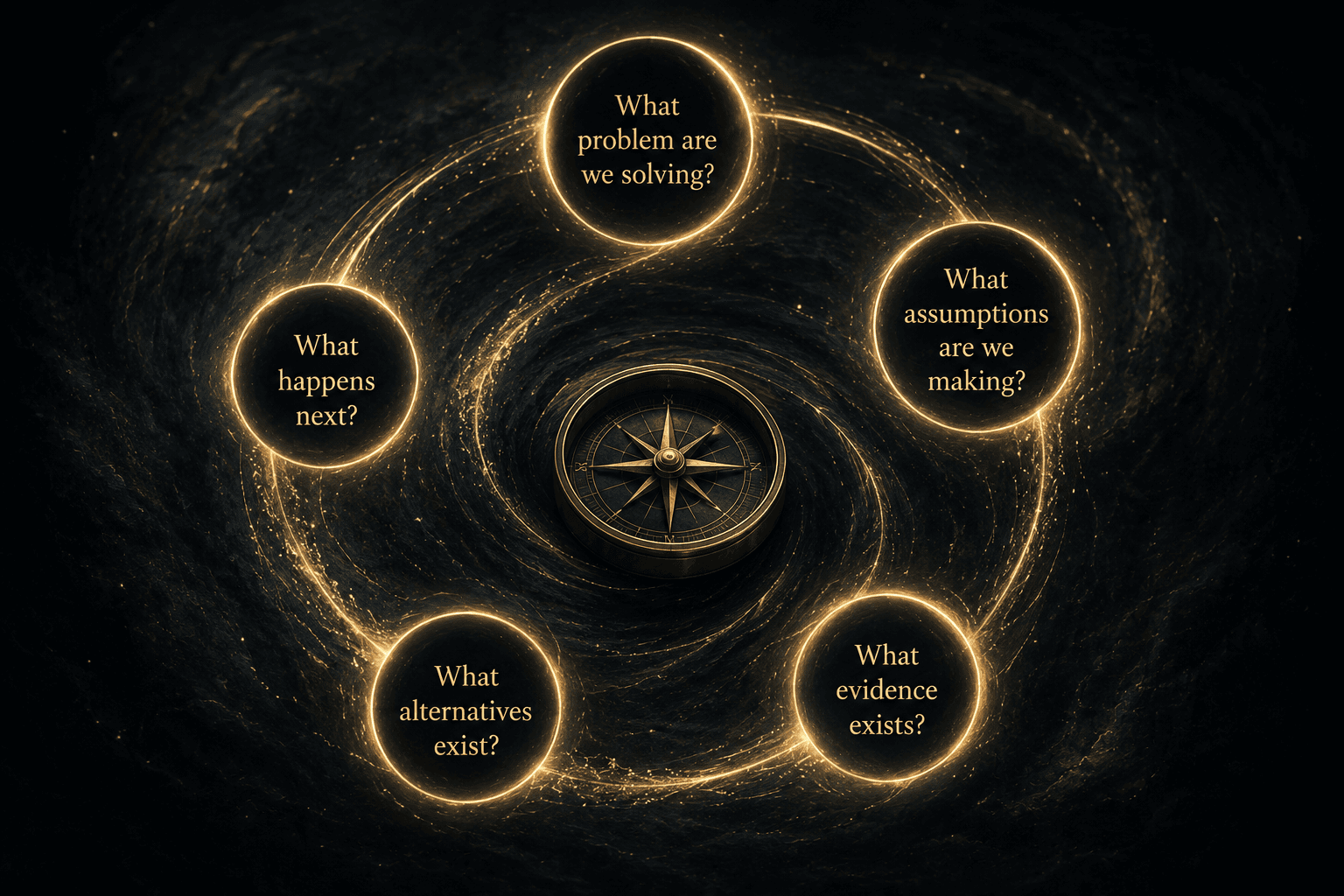
For practical application, Socratic thinking can be distilled into five steps that fit naturally into the rhythm of running a business:
1. Clarify the problem
What exactly are we trying to solve?
Many business challenges are misdiagnosed. A hiring issue may actually be a process breakdown. A revenue problem may stem from positioning, not demand.
2. Challenge assumptions
What are we assuming to be true—and are those assumptions valid?
Unchecked assumptions quietly drive poor decisions. For example, assuming customers are price-sensitive may lead to discounting, when in reality they value consistency or speed.
3. Examine evidence
What data supports this decision? What contradicts it?
This is where discipline replaces instinct. Financials, customer behavior, operational metrics, and feedback loops must all inform the decision—not just intuition.
4. Consider alternatives
What other paths exist?
Strong operators avoid binary thinking. There are often multiple viable approaches—build versus outsource, scale versus optimize, premium versus volume.
5. Assess implications
What happens next if we proceed?
This is where second- and third-order thinking becomes critical. Decisions ripple across cash flow, team capacity, customer experience, and long-term scalability.
Why This Matters for SMB Owners
In larger organizations, structured thinking is embedded into systems, approvals, and governance. In small and mid-sized businesses, that structure does not exist by default.
The owner is the system.
Without a disciplined framework:
- Decisions become reactive
- Mistakes compound quickly
- Teams operate without clarity
- Growth introduces complexity instead of leverage
Socratic thinking introduces structure without bureaucracy. It creates clarity without slowing momentum.
The Compounding Effect: Built-In Future-Proofing
When practiced consistently, this approach does more than improve individual decisions; it reshapes how you anticipate the future.
You begin to:
- Identify risks before they surface
- Detect weak signals earlier
- Stress-test ideas before committing resources
- Develop repeatable patterns of sound judgment
You are no longer just reacting to the business, you are thinking ahead of it.
Consider a simple example: expanding into a new service line.
A Socratic approach forces you to validate demand, question internal capacity, explore partnership options, and model operational strain before committing capital. Many failed expansions are not due to poor execution, but poor questioning upfront.
Making It Operational
This is not a theoretical exercise. It can be embedded immediately into how you run your business:
- Apply these five questions before any meaningful decision
- Use them in leadership and management discussions
- Build them into hiring, pricing, and strategic planning processes
- Revisit past decisions to refine future thinking
Over time, this becomes part of how your business operates—not just how you think.
Beyond the Owner: Elevating the Entire Team
While this discipline starts with the owner, its real impact is realized when it extends across the organization.
Managers and team members who adopt this mindset:
- Communicate with greater clarity
- Solve problems more independently
- Reduce unnecessary escalations
- Make decisions aligned with broader business objectives
It shifts the organization from task execution to thoughtful contribution.
Instead of asking, “What should I do?”, teams begin asking:
- What problem are we solving?
- What assumptions are we making?
- What are the downstream consequences?
That shift is where productivity evolves into effectiveness and effectiveness compounds into excellence.
Final Perspective

Running a business will always involve uncertainty. There is no method that eliminates risk entirely.
But there are methods that dramatically improve how you navigate it.
Socratic thinking is one of them.
And in practice, most business challenges are not solved by working harder; they are solved by thinking more clearly, earlier, and more consistently.
At ThinkQSI, this is exactly where we operate. We work alongside owners and leadership teams to bring structure to thinking, clarity to decisions, and alignment to execution. Whether you are navigating growth, restructuring, or simply trying to make better decisions with less friction, the starting point is always the same: asking the right questions before committing to the wrong answers.
If this way of thinking resonates, the next step is simple "let's initiate the conversation."
---
Insights from Anwer Qureishi, Thought Leader & Entrepreneur
Anwer Qureishi is the Founder & CEO of ThinkQSI, a strategic advisory practice working with founders, operators, and growing businesses. He brings 30+ years of experience as an Advisor/Fractional CXO and has worked with 100+ companies across healthcare, professional services, logistics, and manufacturing.
Ready to accelerate growth? Schedule a Consultation
ThinkQSI - From Chaos to Clarity. From Vision to Victory.